Many people enjoy the sight of a cruise ship in Falmouth Harbour. The classic lines of the QE2 thrilled many. However behind the elegance lies a potent threat to our health.
Cruise ships in port typically use their auxiliary engines to provide electrical power for their passengers. These powerful diesel engines have to run 24 hours a day producing enough electricity for a small town.
As their engines run the ships produce a deadly cocktail of pollutants. Among the worst pollutants are tiny particles PM 2.5 and PM 10, and Nitrogen Oxides (NOX). The latter creates Ozone and is a particular health hazard for anyone with respiratory diseases.
The only effective way in which NOx emissions can be reduced is through the use of on shore power. A number of countries have made the use of on shore power a legal requirement in order to reduce the pollution caused by cruise ships. Most of Falmouth’s cruise ships come from Germany. Hamburg, the starting point for many of the ships that come to Falmouth has installed electrical power to 4 of its 5 berths. Amsterdam’s cruise terminal is following suit.
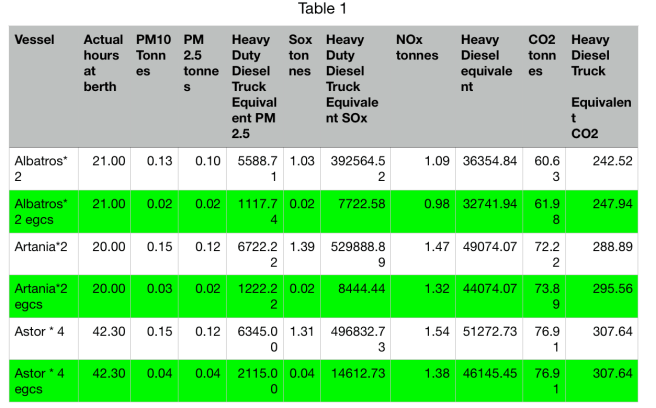
I’ve calculated the amount of pollution three of these visiting ships will bring to Falmouth. The calculation is a standard one used in the marine industry firstly if the ship takes no measures, secondly if it uses scrubbers ( a method of filtering out some pollutants)
On Wednesday 9th May the Albatros docked at Falmouth Harbour. She’s an attractive ship, infamous for going aground on the Scillies, a few years ago. The Albatros returns on 2nd October. On her two visits to Falmouth she will deposit 1.09 (0.98) tonnes of NOx emissions on the town. That’s the same as 36,000 heavy trucks travelling 200 miles. The Albatros will do that on its own in 21 hours.
If its scrubbers are being used it will add as much PM 2.5 particles as 1117 heavy vehicles. If they are switched off there will be 5 times more.
The Artania will be visiting the port on the 2nd June and again in September depositing 1.47 (1.32) tonnes of NOx.
The Astor will make 4 visits giving us 1.54 (1.38) tonnes of NOX Roughly the equivalent of 50,000 HGVs . She’s next due on the 16th July.
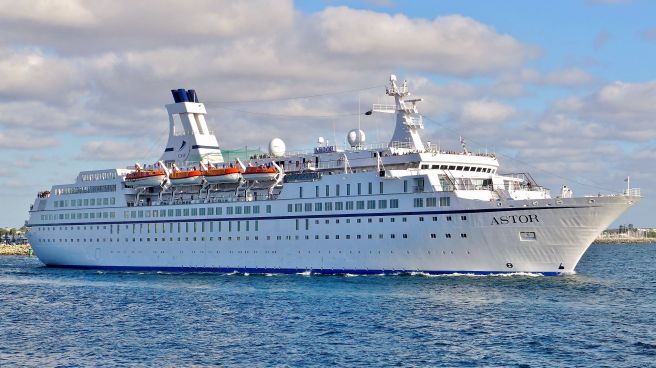
By Bahnfrend – Own work, CC BY-SA 4.0, https://commons.wikimedia.org/w/index.php?curid=47542952
The German ship AIDA Avita was in port on April 30th. An AIDA ship was at the centre of an air pollution storm in Hamburg recently. German campaigners went on board the ship to record the levels of pollution it was putting out. They found out that the average number of health-damaging particles on board this ship stood at 68,000 particles per cubic centimeter, which is about 50 times higher than expected in clean sea air. The shipping line claims that its newer built ships are less polluting.
Falmouth streets like Bar Street and Arwenack Street with their canyon like structure are known to respond badly to even low levels of pollution.
County Council officials to date have not carried out any monitoring of air quality in Falmouth. So I thought I would do my own. Armed with a small portable AQ instrument as used by the BBC and Channel 4 for their documentaries on air quality.
I walked round Falmouth on Sunday late afternoon. There were no cruise ships in dock and very little road traffic so air pollution levels should have been low. Even Trago was quiet. API readings reached 90 around the Maritime Museum and parts of Arwenack Street. A level over 100 would be considered a cause for concern. It will be interesting to see what impact a Cruise ship would have on these baseline figures.
Cornwall County Council needs to institute a proper programme of monitoring pollution from cruise ships. It should follow the lead of the US ports and require all visiting cruise ships to use onshore electricity supplies.
Harbour authorities and the County Council need to require that all cruise ships install particulate filters, SCR catalysts and use genuinely low sulphur fuel as a condition of port entry.
Notes
Table shows cruise ship and no of visits (x2)
First row are emissions with no particular environmental measures
The second row (EGCS) shows the cruise ship emissions if it is using low sulphur fuel and scrubbers.
ECGS reduces some pollution eg Sox but has little or no effect on NOX
Categories:Uncategorized


Leave a Reply