The Cruise Ships arrive:- time for celebration or gas masks.
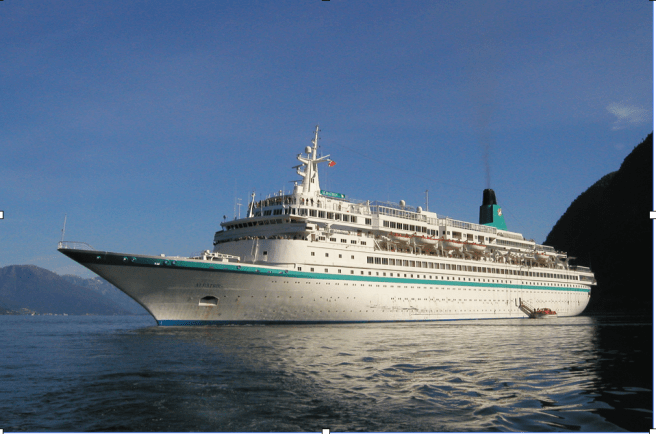
Spring is coming and so are the Cruise Ships. Many people enjoy the sight of a cruise ship in Falmouth Harbour. The classic lines of the QE2 thrilled many. However behind the elegance lies a potent threat to our health. It might be time to start dolling out the gas masks.
Cruise ships in port typically use their auxiliary engines to provide electrical power for their passengers. These powerful diesel engines have to run 24 hours a day producing enough electricity for a small town.
As their engines run the ships produce a deadly cocktail of pollutants. Among the worst pollutants are tiny particles PM 2.5 and PM 10, and Nitrogen Oxides (NOX). The latter creates Ozone and is a particular health hazard for anyone with respiratory diseases.
The only effective way in which NOx emissions can be reduced is through the use of on shore power. A number of countries have made the use of on shore power a legal requirement in order to reduce the pollution caused by cruise ships. The starting point for many of the ships that come to Falmouth is Hamburg. The German port has installed electrical power to 4 of its 5 berths. Amsterdam’s cruise terminal is following suit. There are no plans for Falmouth to follow suit.
I’ve calculated the amount of pollution a sample of these visiting ships will bring to Falmouth. The calculation is a standard one used in the marine industry firstly if the ship takes no measures, secondly if it uses scrubbers ( a method of filtering out some pollutants).
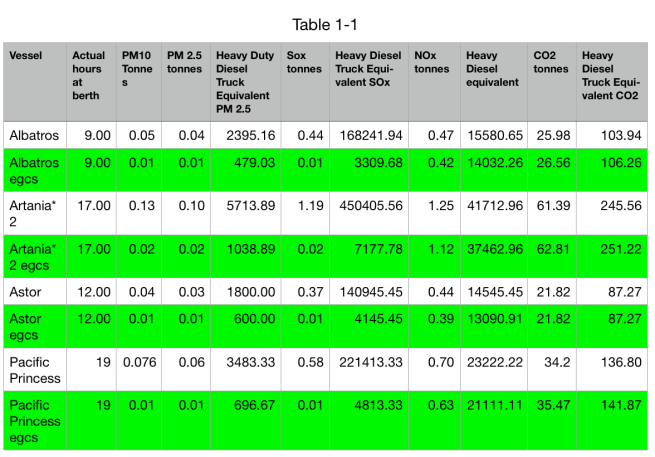
On Saturday 12th May the Artania visits the port for the first of two visits. She comes here again in August. With her scrubbers on she will add as much PM 2.5 particles as 1,038 heavy diesel trucks parked on Events Square with their engines running for 17 hours. If the scrubbers are off the figures rise to 5,713 diesel trucks.
Later in September the Albatros will dock at Falmouth Harbour. She’s an attractive ship, infamous for going aground on the Scillies, a few years ago. On her visit to Falmouth she will deposit just under half a tonne of NOx emissions on the town. That’s the same as 14,000 heavy trucks travelling 200 miles. The Albatros will do that on its own in 9 hours. In that time she will also produce 60 tonnes of CO2 emissions.
The Pacific Princess visits Falmouth twice, at the end of July and again in September. If she is using scrubbers that’s 696 diesel trucks worth of fatal PM2.5 particles running for 19 hours.
The German ship AIDA Avita is visiting the port twice in September. An AIDA ship was at the centre of an air pollution storm in Hamburg recently. German campaigners went on board the ship to record the levels of pollution it was putting out. They found out that the average number of health-damaging particles on board this ship stood at 68,000 particles per cubic centimeter, which is about 50 times higher than expected in clean sea air. The shipping line claims that its newer built ships are less polluting.
Cruise ships are not the only cause of air pollution in ports but they are a major factor. The impact of cruise ships on the local economy is surprising low. Their environmental impact is surprisingly high. Almost all other forms of tourism deliver higher pound for pound benefits. No one would dream of suggestion that we park 2000 motorhomes on the Event Square car park, and ask them to keep their engines running overnight. Yet the economic benefit would be far higher.
Ports across the world are introducing full environmental audits, taking appropriate measures and marketing themselves as Green Ports. In some Incentives are offered to ships docking dependent on their emission controls.
Falmouth should be setting a lead on these issues instead of lagging behind.
Falmouth streets like Bar Street and Arwenack Street with their canyon like structure are known to respond badly to even low levels of pollution.
Yet County Council officials to date have not carried out any monitoring of air quality in Falmouth.
Cornwall County Council needs to institute a proper programme of monitoring pollution from cruise ships. It should follow the lead of the US and other countries’ ports and require all visiting cruise ships to use onshore electricity supplies.
Harbour authorities and the County Council need to require that all cruise ships install particulate filters, SCR catalysts and use genuinely low sulphur fuel as a condition of port entry.
Notes
Table shows cruise ship and no of visits (x2)
First row are emissions with no particular environmental measures
The second row (EGCS) shows the cruise ship emissions if it is using low sulphur fuel and scrubbers.
EGCS reduces some pollution eg Sox but has little or no effect on NOX
Categories:Uncategorized

 kernow left
Leave a comment